Labor Crunch Tests Growth Limits for US Data Center Builders
Following several quarters of record order books, a skilled-labor shortage is testing the limits of growth for the craft-labor providers who build data centers across the US.
While some executives have downplayed the strain, others acknowledge that a lack of electricians, pipe fitters and site supervisors is forcing them to turn away work or poach crews from smaller contractors to keep projects staffed.
Forward‑looking earnings estimates underscore the bottleneck. Revenue growth for major craft‑labor suppliers including Sterling Infrastructure Inc., MasTec Inc., Quanta Services Inc., Emcor Group Inc. and Comfort Systems USA Inc. is generally expected to moderate after a blockbuster stretch.
That reflects how a tight labor market, rather than any cooling in demand, is constraining expansion, Bloomberg Intelligence analyst Scott Levine said.
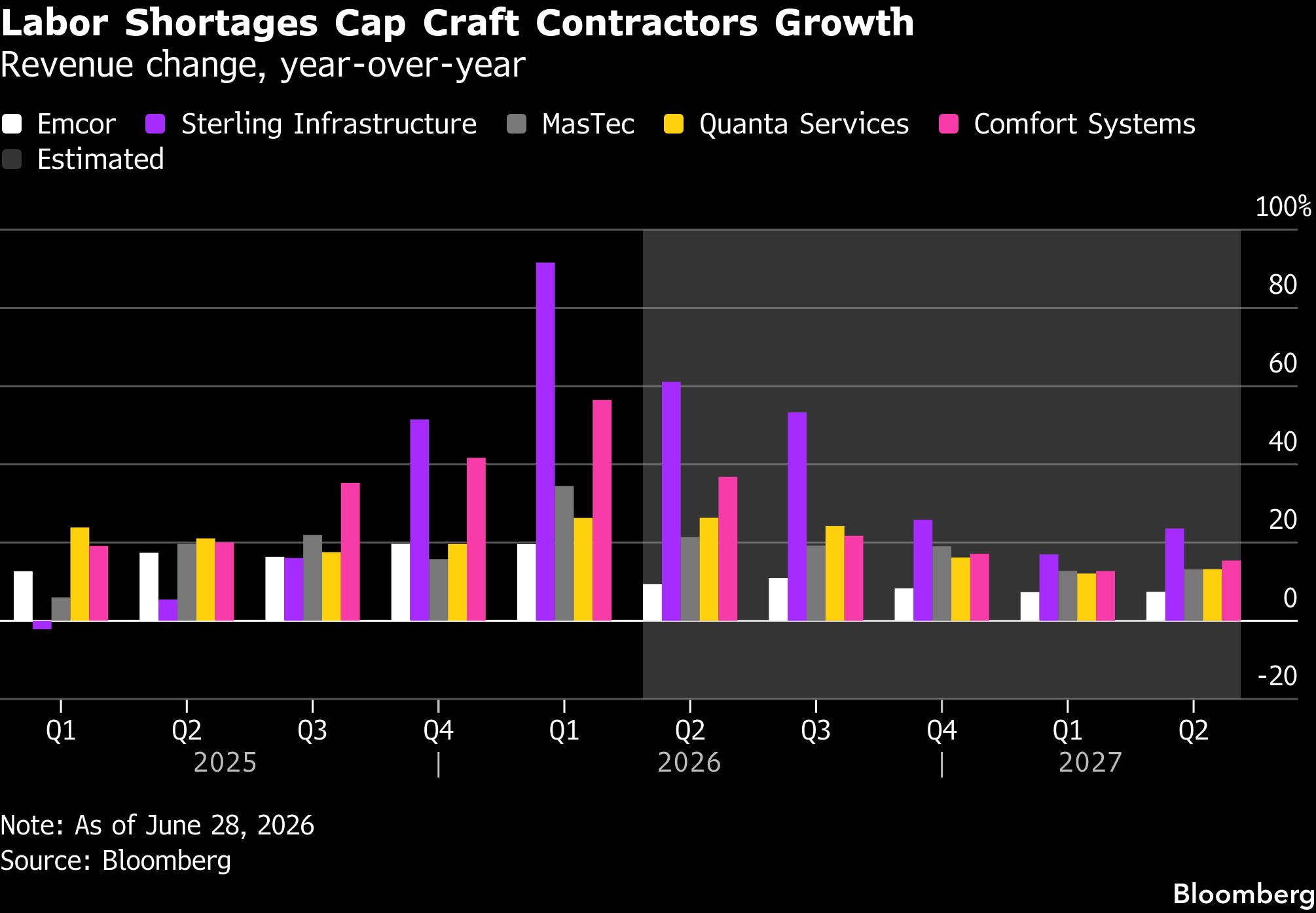
These estimates will likely be revised higher as the firms’ backlog materializes, KeyBanc analyst Sangita Jain said.
Mechanical, electrical and plumbing service provider Comfort Systems’ latest book‑to‑bill ratio slowdown reflects supply constraints, not weaker demand, Chief Financial Officer William George said in a June earnings call. “There is plenty more work we could take if we could possibly do it.”
The construction sector is contending with an aging workforce, too few young people entering the trades, and a lack of apprenticeship, community‑college and pre‑college training programs, Associated General Contractors of America’ Director of Market Insights Macrina Wilkins said.
That’s prompting companies to raise pay, lean on staffing firms and union contractors, and step up recruiting through social media and high‑school outreach.
Wage data reflects the pressure. While overall US pay rose 2.4% between May 2025 and 2026, hourly wages for construction increased 3.4% in the same period, data from Indeed showed.
Electrician roles illustrate this most clearly, said Indeed economist Sneha Puri, with year-over-year wage growth of 4.6% for electricians, 6.6% for journeyperson electricians, 8.2% for apprentice electricians, and 9.9% for commercial electricians.
Electrical work accounts for about half of all labor on data center projects, said Michael Bellaman, chief executive officer of the Associated Builders and Contractors trade association.
US employment in electrical, plumbing, and heating, ventilation and air conditioning, or HVAC, has risen 30% since 2016, according to a Bureau of Labor Statistic analysis from Levine. By comparison, the combined project backlogs at Comfort Systems, Emcor, and Sterling have surged sixfold over the same period, Levine wrote in a note.
Tighter immigration enforcement is compounding the strain, with foreign‑born workers making up 35% of the construction‑trades workforce, Wilkins said. That compares with about 19% across all industries, Bureau of Labor Statistics data show.
‘Stealing’
Large contractors are becoming more aggressive in response.
Sterling Infrastructure is “stealing” crews from smaller shops, Chief Executive Officer Joseph Cutillo said at a conference in June. While the company has an in‑house training program, it takes four years to turn a recruit into a certified electrician, Cutillo said. “We can’t run thousands of people through that a year, which we’d like to have.”
“In the tight labor markets, what you’ll find is preferred employer status will draw a traction,” Karl Studer, Quanta Services’ president of electric power, said at an investor day in March. MasTec also touted its employer of choice status.
The labor crunch may ultimately benefit these craft-labor giants, as they can leverage steady project pipelines, corporate training programs and safer indoor prefabrication plants to secure headcount compared with smaller players, KeyBanc’s Jain said.
Companies are being selective about projects as they believe they have to “do the job effectively to have good expectation and good margin,” Jain said.
A modest silver lining for contractors may be graduates struggling to find work. Some eventually circle back to construction after searching for jobs aligned with their degrees, and the industry is attracting more of them than in the past, Bellaman said.
Still, they are not a quick fix given the training required and the stigma around blue‑collar work, Wilkins said.
Photo: The Target Hospitality data center camp near Afton, Texas. Photographer: Mark Felix/Bloomberg
- World’s Largest Retirement Community Set to Borrow $180 Million for More Homes
- Reuters: DXC in Advanced Talks to Sell Insurance Software Unit for $2.4 Billion
- How One Hacker Used AI Agents, a Few Thousand Dollars to Break Into Websites
- EU Cyber Agency Warns Websites May Go Dark as PHP Prepares Critical Fix