How Colorado Sparked a Global Push for Salary Transparency
Colorado cracked open the culture of secrecy around salaries when it started forcing employers to include pay ranges in job postings. It also sparked an international trend.
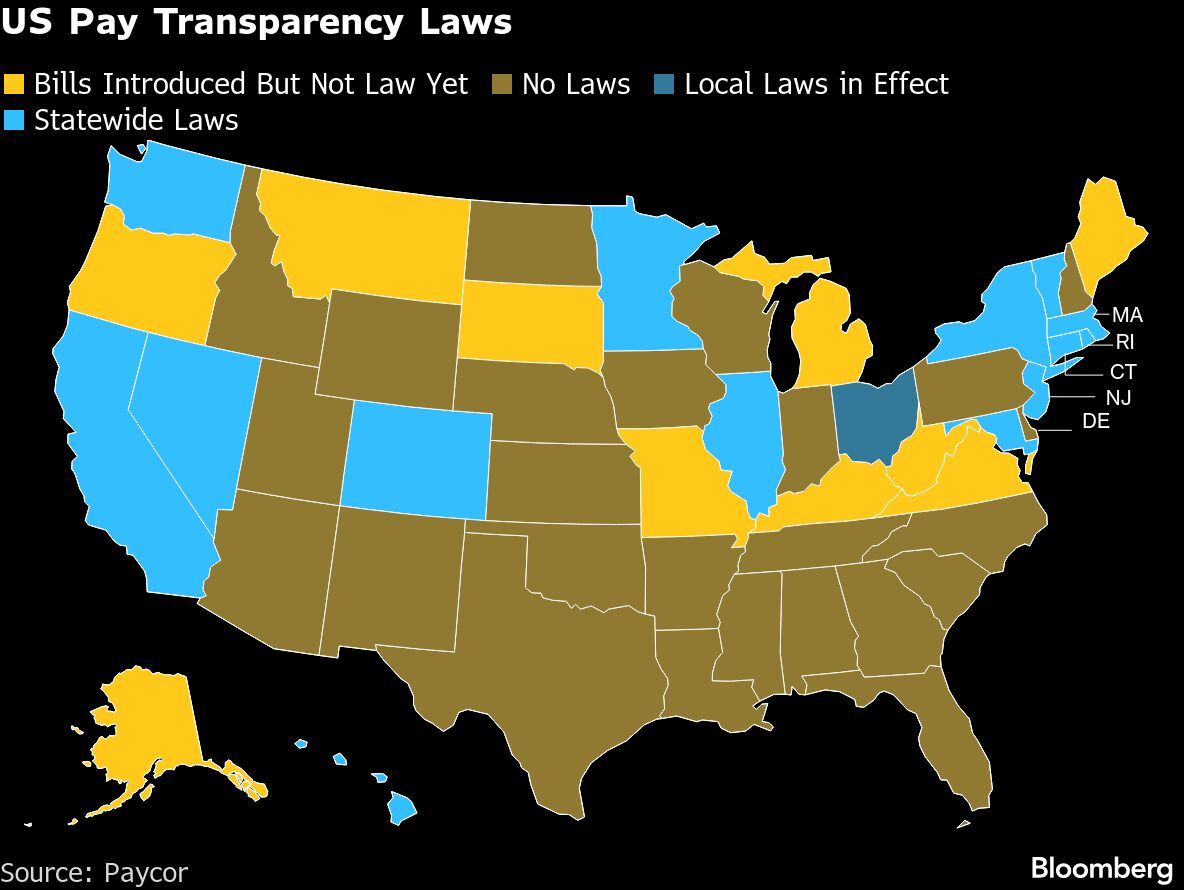
Since the state’s rule took effect in 2021, about a dozen other states across the U.S. have adopted similar requirements, and the European Union will follow suit later this year.
Pay-transparency laws aim to make it easier for workers to gauge their worth in the labor market and compare job opportunities. They’re also meant to make it harder for employers to underpay people who might not fully grasp their bargaining power, one driver of the gender wage gap.
The effectiveness of pay-transparency laws has been mixed, but interest in them remains high, with at least another dozen states considering legislation.
Colorado was an unlikely trailblazer in the drive to shine a light on pay. While an early mover in legalizing marijuana and advancing green energy, it doesn’t have the reliably progressive politics of California. Nor does it have the powerful organized-labor interests of New York. But in 2019, conditions were ripe for a salary disclosure law to pass in Denver.
The state had become a magnet for a new generation of tech workers who saw little taboo in discussing salaries. The national #MeToo movement had reignited interest in women’s rights and equal pay, areas where state lawmakers tried to make inroads decades before. And with Democrats in control of the governor’s mansion and both statehouse chambers for the first time in years, previously stalled bills got passed in a legislature with one of the largest shares of women lawmakers in the country.
“There was just more fertile ground here,” said Michael Bell, an employment lawyer at Ogletree Deakins in Denver.
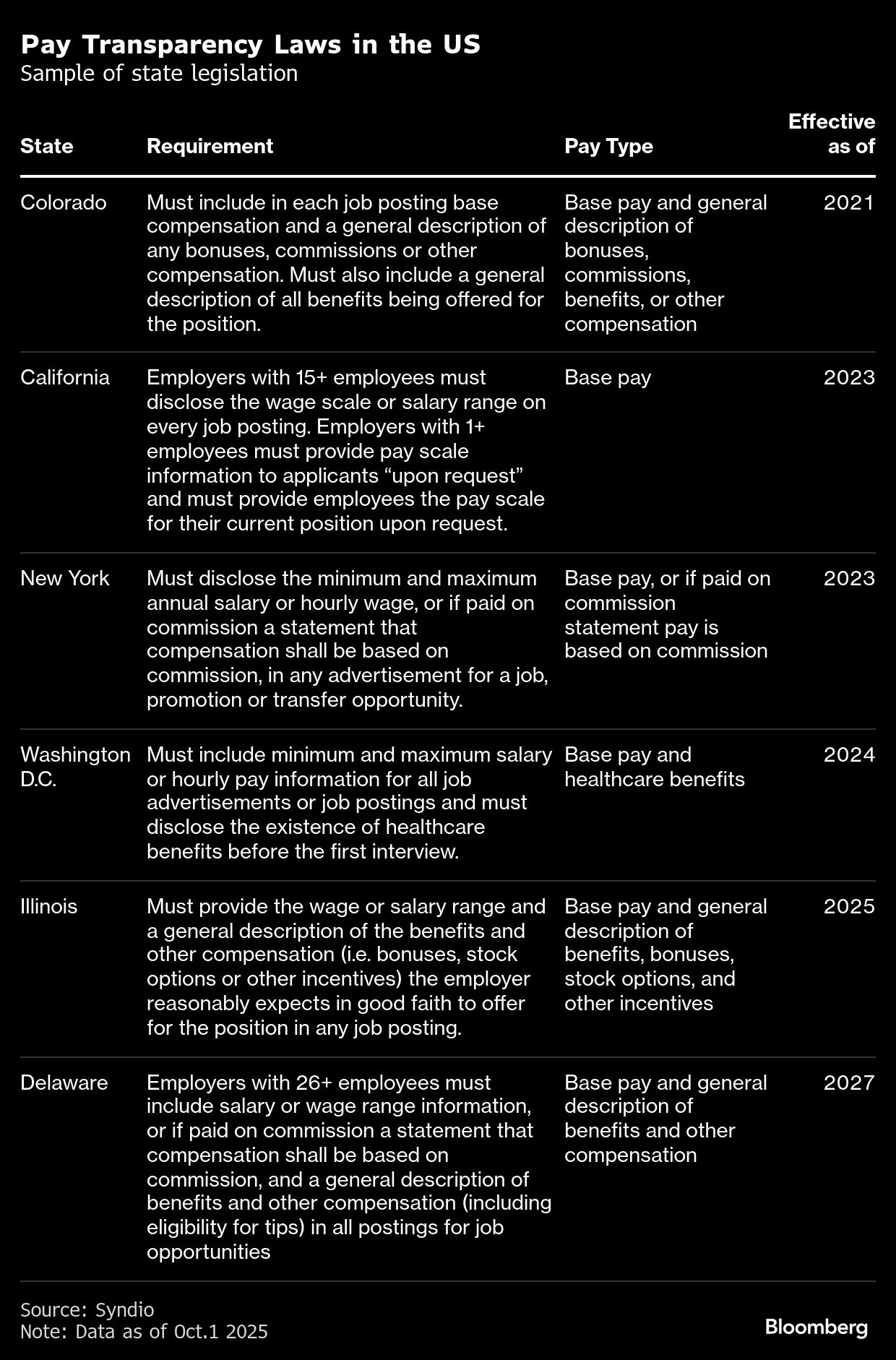
Colorado’s law requires employers to specify pay ranges, as well as related benefits such as healthcare, in all job postings. It also bars them from asking job candidates about their pay history or using it to determine wages, practices that have been found to perpetuate the pay discrimination often faced by women. When the law passed, women in the state were earning 80 cents for every $1 paid to men with similar qualifications, according to the National Women’s Law Center. By 2024, relative wages for women averaged 85 cents.
Colorado’s pay-transparency rules coincided with the Covid-19 pandemic and the rise of remote work. Companies advertising remote roles initially tried to sidestep the state’s salary-posting requirement by barring Colorado residents from applying. But other states including California, New York and Washington soon adopted pay-transparency laws of their own, making it more difficult to avoid posting salary ranges.
As the policies spread, employers grew more likely to post salary ranges in job ads even in states without disclosure mandates, according to an analysis by the National Women’s Law Center in 2024.
Disclosure rules took effect in five more states in 2025: Illinois, Minnesota, New Jersey, Vermont and Massachusetts. This year, EU countries will enact rules mandating the inclusion of pay ranges in advertised positions, and in 2027, companies in the EU must report their mean and median gender pay gaps.
Jessie Danielson, one of the state senators who introduced the Colorado bill, said she has since advised counterparts in other states on building support for equal-pay legislation.
In Colorado, Danielson and her supporters on the pay-transparency bill could draw on the state’s history of championing women. Colorado was one of the first states to grant women the right to vote and also was the first to elect women to its legislature, in the 1890s. Nevertheless, the fight in the statehouse for wage equality was a decades-long slog.
Former State Senator Polly Baca, the first Hispanic woman in Colorado’s legislature, said she and other Democrats introduced pay-equality bills year after year in the 1980s. She was encouraged to find bipartisan support for at least one of her proposals, but the bills kept failing.
Baca said she was motivated by her own experiences in the 1960s, when she was working at a labor union newspaper and learned that a male colleague earned more for the same job. Baca eventually got a pay raise but the frustration spurred her to tackle wage discrimination as a lawmaker, she said.
Promoting equal pay is only one way of addressing gender gaps in the workplace. “There needs to be fair access to education, childcare, transportation and paid family leave so that everyone can participate in the workforce,” said Louise Myrland of the Women’s Foundation of Colorado, which advocated for the state’s wage-transparency law.
Business groups including the National Federation of Independent Business and Denver Metro Chamber of Commerce argue that Colorado’s transparency rules place heavy administrative and legal burdens, especially on smaller companies that lack compliance staff and could be subject to fines of up to $10,000 per violation.
“It’s a laudable goal,” said Denver Metro Chamber President J.J. Ament, but it was “made by policymakers who don’t understand how hard it is for a small business to comply and the risks that have been created if they make a mistake.”
Larger firms have also faced penalties. Defense contractor Lockheed Martin Corp. paid a $79,500 fine in 2022, while social media company Twitter Inc., now called X, paid about $28,000 that same year, according to Colorado’s labor department. Healthcare company DaVita Inc. settled for a $298,000 penalty in 2025.
A Lockheed spokeswoman said in a statement that the company is committed to fair treatment and equal opportunity, and complies in good faith with all nondiscrimination and pay-transparency laws. DaVita, based in Denver, said in a statement that a small portion of its public job listings had inadvertently omitted information required by the Colorado law and has since made sure those details are now included. X didn’t return emails seeking comment.
The Colorado Restaurant Association and Foundation said expenses tied to the transparency rules are negligible compared with the rising cost of food and rent faced by restaurants today. The group, which opposed the law, helped to amend it in 2023, securing changes to ensure pay ranges can account for things like experience and location, and to allow for wage negotiations without reposting jobs, a CRAF spokeswoman said.
Initial studies of the effects of pay-transparency laws have been mixed.
A 2025 study by academics at University of California, San Diego and University of Southern California found that Colorado’s law bolstered competition in the labor market, while wages increased as much as 3.6%.
But a national study from 2023 published in Econometrica, a journal of the Econometric Society, found that transparency policies weakened workers’ individual bargaining power. Many employers chose not to raise wages for any one worker because doing so could spur costly renegotiations with other employees, the researchers said.
Meanwhile, national data show wage gaps have recently widened. Women working full-time were paid 81 cents for every dollar paid to men in 2024, down from 84 cents two years prior, according to the National Women’s Law Center.
Democrats in Congress last year introduced a bill to require salary range disclosures nationwide. It’s still sitting in committee. Meanwhile, the Trump White House’s hostility to gender-equality efforts has further elevated the need for state governments to step in, said Danielson, the Colorado legislator.
“It makes the work that the states have done and will do, especially on things like women’s rights, workers’ rights, equal pay, more important than I ever thought,” she said.
Top photo: Former Colorado state legislator Polly Baca in Denver. Photographer: Jimena Peck/Bloomberg.