Deadly Screwworm Spreads Fast With Milder Weather Fueling Resurgence
The New World screwworm has made a comeback in the US after months of relatively muted cases, thanks in large part to milder temperatures and humidity that are encouraging the deadly livestock parasite’s activity.
More than 40 cases of screwworm have been confirmed so far in November, already making it the worst month since the pest first appeared in Texas earlier this year, according to the US Department of Agriculture. Cases began accelerating in October, when the pest spread to Arizona for the first time.
There have been a total of nearly 130 cases in the US, with more than 60 currently active.
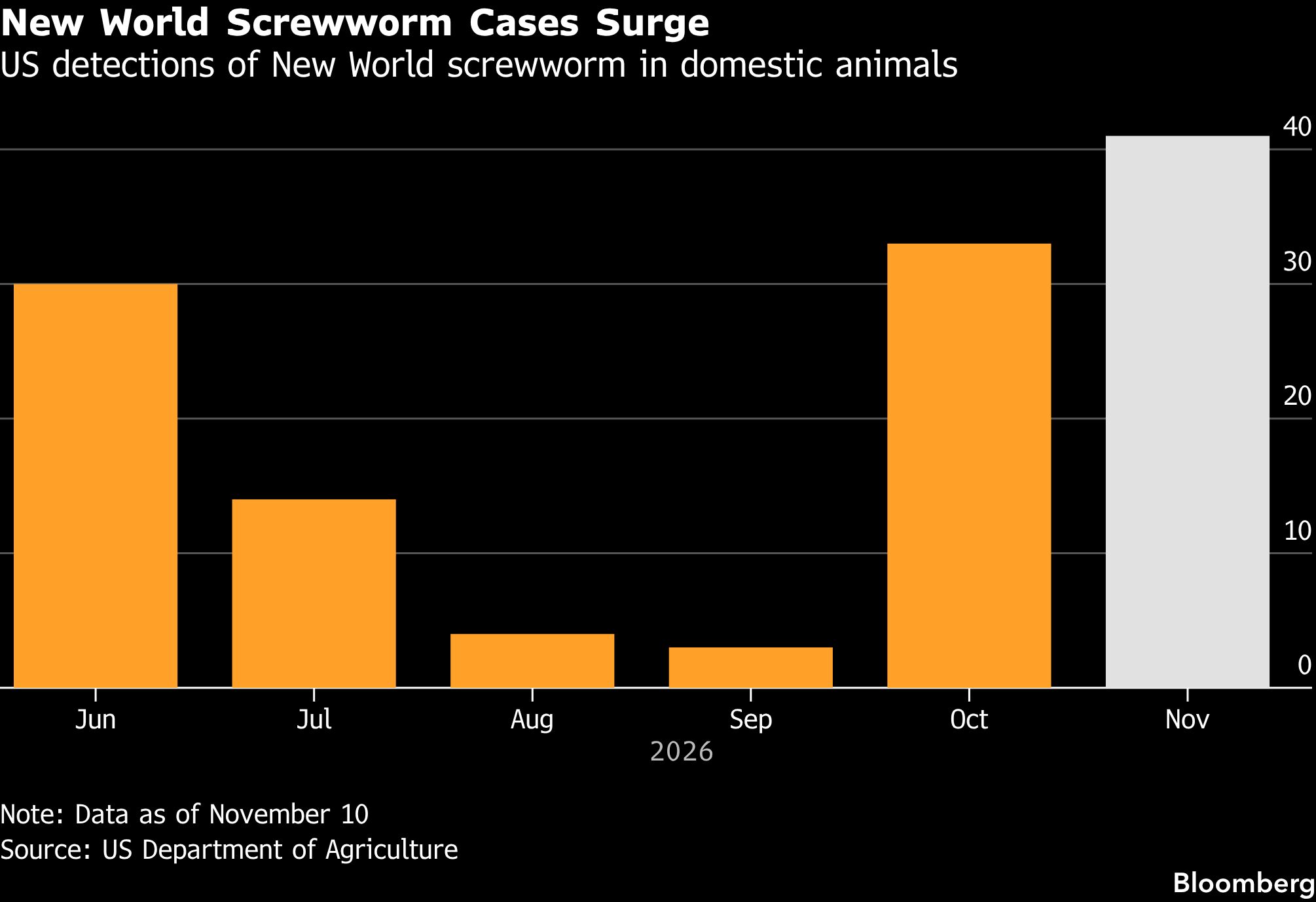
When screwworm first arrived in the US in June, “a lot of us were like, ‘Okay, yep, we’re in for a rough summer,'” said Caleb Hubbard, an assistant professor of urban entomology at New Mexico State University. But there were much fewer cases than feared.
In hindsight, the US had just gotten lucky: Screwworm flies like warm weather, but not the extreme above-100F days that Texas and New Mexico faced in July and August. The parasite is less active in such temperatures, both in movement and in reproduction. Colder temperatures — below 59F — also make the flies more sluggish.
“It was something that I think we all were like, ‘Whew, we got through it, we’re all good,'” Hubbard said of the hotter summer days. “But as temperatures have started to decline, at least in the Southwest, we’re kind of in this Goldilocks zone right now” for the screwworm.
The parasite’s life cycle can be as short as two to three weeks in ideal conditions, above 80F — but below 100F — with high humidity, according to Texas A&M University. Screwworms only mate once, but during that short window in that temperature zone they are more active, with greater opportunities for the population to grow.
Extreme heat in Texas when the fly first arrived created “actually a pretty hostile environment,” said Phillip Kaufman, an entomology professor at Texas A&M. “We finally have started getting some cooler weather — not cold, but cooler weather here, and there has been an uptick in rain events, particularly over Arizona, New Mexico, and West Texas,” exactly where the fly has been detected.
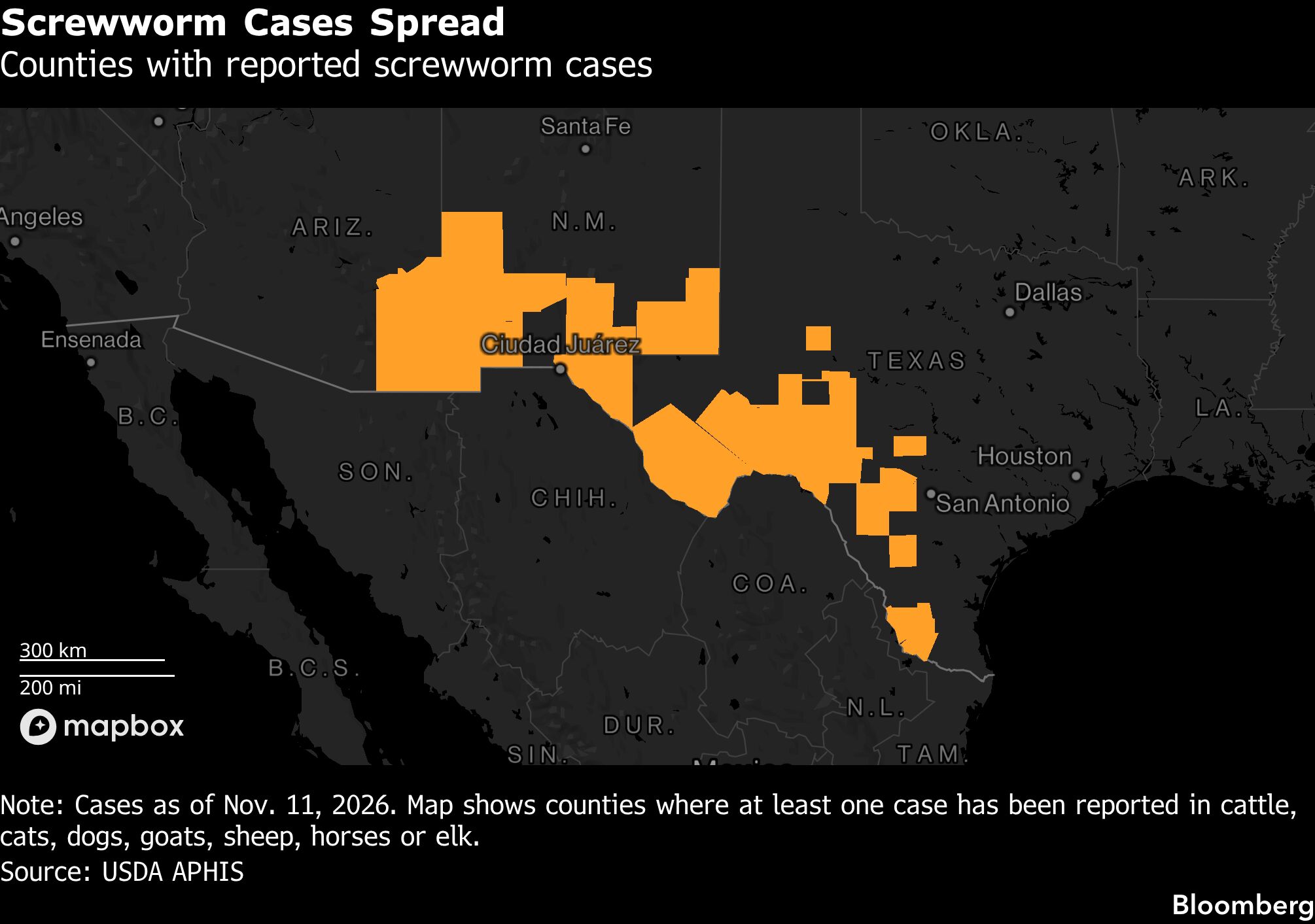
The spread to Arizona is “part of a natural progression” as the pest pushes westward from Texas, and northward from Mexico, Mykaela Martin, public information officer for the Arizona Department of Agriculture, said in an email.
Despite the rapid acceleration, the outbreak is still minuscule compared to the 95,000 cases that the US reckoned with in its worst outbreak in 1972. Cases at that time stretched across all of Texas, up into Oklahoma and as far west as California.
The USDA to a large degree was able to contain the current outbreak through the summer with livestock movement controls, a monitoring and surveillance program, and the dispersing of sterile flies for curbing the screwworm’s reproduction.
The agency said in an emailed statement that the current weather patterns are “certainly conditions that could cause an increase in fly survivability, though it is difficult to determine a sole reason” for the recent jump in cases.
Other explanations for the uptick in infections and wild flies caught in the USDA’s traps include the movement of animals. The fly does not travel very far on its own and depends on either livestock or wildlife to spread.
That has raised concerns among some ranchers that the USDA acted prematurely in resuming cattle imports from Mexico, where there are currently about 1,500 active cases. Trade from Mexico had been halted to prevent the spread of screwworm, but imports resumed in late August.
More than 65,000 cattle have crossed the border since the US reopened ports, according to the USDA. The agency has said rigorous inspection protocols make it unlikely that infected animals will enter the country, and the agency plans to keep the ports open despite the increase in cases.
Read More: US Won’t Halt Mexican Cattle Imports Despite Screwworm Surge
Meanwhile, the USDA’s main weapon in eradicating the pest — a facility in Texas that would significantly increase the production of sterile flies — isn’t slated to open until next spring.
The USDA said in a posting on X that it has shifted its sterile fly releases to “the areas of greatest need” in Arizona and New Mexico, though it continues to release the insects in some areas of Texas.
That leaves the US dependent on a cold and dry winter to tamp down cases. But it’s unlikely the Southwest will stay cold for long enough to discourage the fly’s spread, while dry weather would thwart ranchers who need rain to support their pastures.
A fast-building “super” El Niño will likely help break the drought that’s crept into much of Texas and parts of the Southwest. The weather pattern typically douses the southern third of the country with heavy rains throughout the winter months, which may result in wetter soil that helps flies grow.
El Niño usually has a cooling effect through the southern US, but long-term climate change has made the region notably hotter over the last three decades, according to John Nielsen-Gammon, who directs the Southern Regional Climate Center and serves as state climatologist for Texas.
In some counties battling screwworm, even the coldest winter nights have still seen temperatures lodged in the mid-50s in recent years.
“When Arctic air makes it down this far, it’s not as cold,” Nielsen-Gammon said. “The weather tends to be more cloudy and dreary rather than having sharp cold during an El Niño.”