Deadly Screwworm Pest Spreads in Texas With Two New Cases
The US Department of Agriculture confirmed an additional two cases of New World screwworm in Texas, bringing the total number of detections in the US to four and raising concerns that the parasite is spreading in the state.
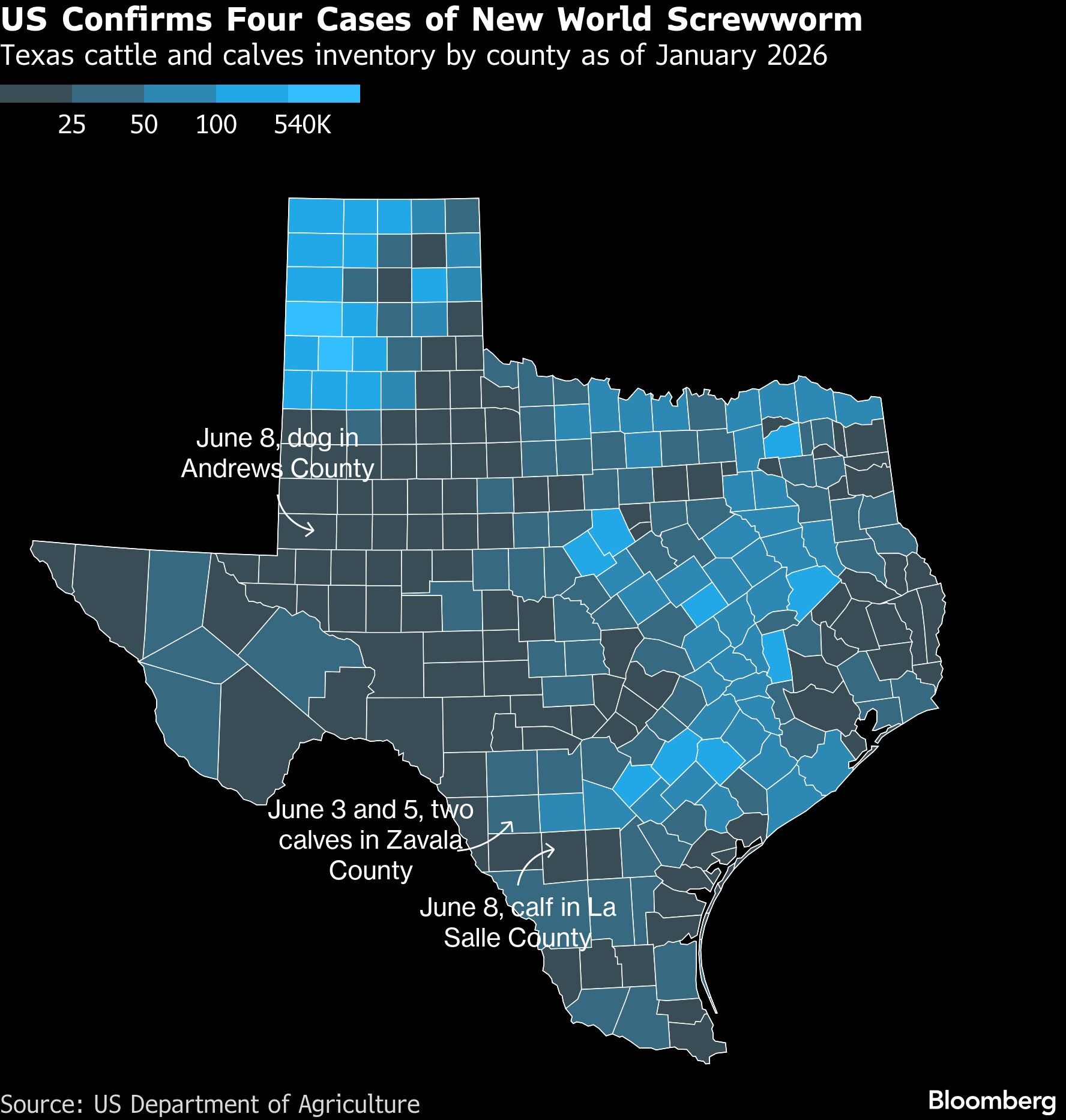
The parasitic fly was detected in a calf in La Salle County and a dog in Andrews County, the agency said in a Monday release. That comes after two cases were confirmed last week in calves in Zavala County in South Texas, marking the first US detection of the fly in over a decade, and the first in cattle in about five decades.
The latest detection in La Salle County is close to Zavala, where the past two cattle cases were confirmed. But the confirmation of screwworm in a dog in Andrews County is significantly further north. Epidemiological investigations are continuing for both cases, but early reports indicate the dog was recently in Mexico, the USDA said.
Agriculture Secretary Brooke Rollins, speaking on CNBC on Monday, said the US is “going to do everything we can, investing over $1 billion” to push the New World screwworm out of the country.
The screwworm is a fly whose larvae burrow into the flesh of animals, leading in some cases to death. Infestations are treatable, including through a spate of medications the US Food and Drug Administration has already approved under emergency use, and the USDA has said the food supply is safe.
The 1976 outbreak in Texas affected over 1.5 billion head of cattle and was ultimately eradicated through the dispersal of sterile flies that limited the pest’s ability to reproduce. The USDA plans to release eight million sterile flies each week to the current control zone, which spans 20 kilometers (12 miles) around the initial detection in La Pryor, in Zavala County.
The dispersal of such flies will need to reach 400 million a week, Rollins said. A facility in Panama produces and disperses 100 million flies a week, “but we need a lot more than 100 million flies a week to eradicate,” Rollins said.
A production facility under construction in Texas — the first of its kind in the US — is expected to produce 100 million flies a week once it begins operating in November 2027, with further growth to full capacity of 300 million flies a week.
- Hordes of Teens on E-Bikes Force Suburbs to Rewrite Road Rules
- Insurance Executive Killed His Wife, Daughter, Then Himself, NJ Township Police Say
- Two Past Hurricanes, OIR Data Give Idea of What to Expect From Isaias in Florida
- Hurricane Isaias Reaches Cat 3 Status as Insurers, Adjusters, Property Owners Prepare