Global Wildfire Surge Hits US, Propelled by Rising Temperatures
The US is enduring one of its worst wildfire seasons in years, with blazes scorching millions of acres. It’s part of a global pattern of hot, dry conditions that favor fires becoming more common with climate change.
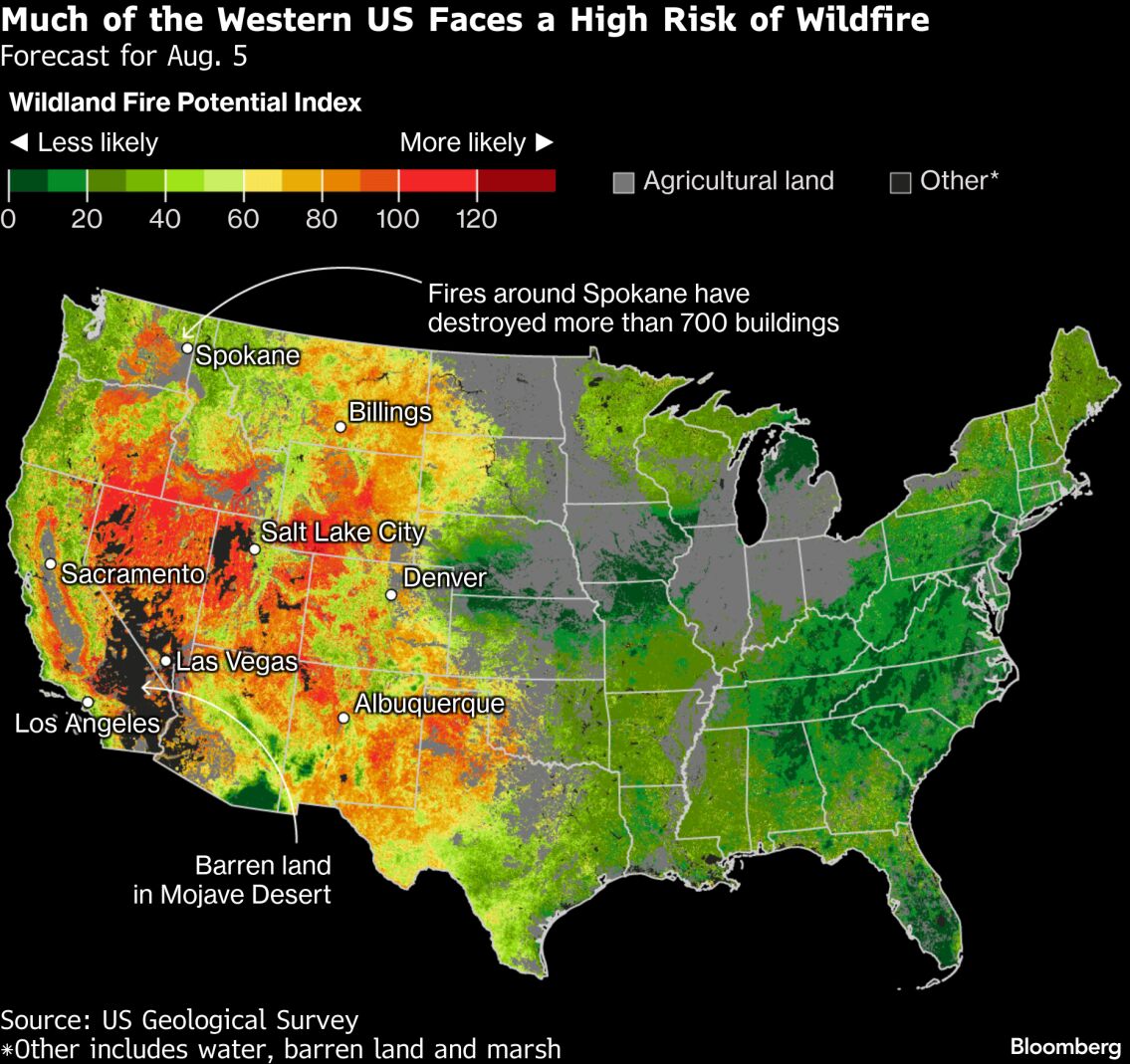
Fires that erupted over the weekend in and around Spokane, Washington, have destroyed hundreds of structures and forced more than 60,000 from their homes — about 10% of the population. Three major fires have burned more than 8,000 acres and have not been contained, according to InciWeb, a federal fire-tracking website. There are 17 total fires currently active across Washington, Public Lands Commissioner Dave Upthegrove said on Monday.
Meanwhile, ongoing fires in Greece have consumed tens of thousands of acres and triggered evacuations. These conflagrations follow the historic fires that raged in France and Spain last month, displacing hundreds of thousands of residents.
All these fires broke out in different regions and ecosystems. But they’re examples of the same underlying shift: Rising temperatures are worsening wildfire risk. It’s happening in two ways at once. First, traditional fire country is becoming hotter and drier in all regions. Second, the range of landscapes that can sustain destructive blazes is growing broader.
“We’re seeing both, in the same moment, in different places, in different ecosystems,” said Daniel Swain, a University of California climate scientist who studies wildfire. “The commonality between all of them is that there has been a substantial period of record-breaking warmth and/or dryness.”
Swain describes the phenomenon as “lifting the flammability veil.”
Some parts of the world have always been susceptible to burning but rarely became hot and dry enough, for long enough, to support large fires. Now global warming is “putting a thumb on the scale, producing severe and unprecedented heat waves,” said Noah Diffenbaugh, a professor of Earth system science at Stanford University.
Trees lose moisture over extended periods of exceptional heat and dryness, becoming progressively more combustible. That has a stronger impact in ecosystems like Canada’s boreal forests, California’s Sierra Nevada mountains and parts of temperate Europe that evolved under relatively cool, moist conditions. Unlike many forests in the American Southwest, where trees are adapted to seasonal drought and frequent fire, these forests can become tinderboxes when subjected to weeks of unusual heat.
Mojtaba Sadegh, a wildfire researcher at Boise State University, compared a heat wave’s effect on a landscape to the toll it takes on the human body. Successive days of high temperatures are much more dangerous than a single day. “The physiology of the human body takes several days to kick in,” Sadegh said. “The same happens with vegetation.”
In research published last month, a team of scientists including Sadegh identified “fire weather waves,” or prolonged episodes of exceptionally hot, dry and often windy weather. Forest regions of the world experienced such a wave on an average of 4% of all days between 1979 and 2024. But the waves coincided with more than a quarter of land area burned and nearly half of the most energetic forest fires. The researchers found these episodes have become more frequent in most regions since 1979 and project that trend will continue.
Across the US, signs pointing to an active fire season were already there in April: Air tanker outfits, which fight blazes from the sky, were busy. By June, the National Interagency Fire Center warned it could be a bad year across the Pacific Northwest and Northern California.
Last winter, the Pacific Northwest, Rocky Mountains and large parts of California experienced a snow drought. Instead of feet of snow covering the landscape, mountaintops remained bare. This robbed the landscape of its natural replenishment that happens every spring and early summer when the snow melts and the waters run, leaving not only the grasses and shrubs dried out, but starving trees of moisture.
But extreme precipitation, not just the lack of it, plays a role in worsening fire conditions too. Deluges promote the growth of vegetation that then becomes fuel. Swain noted that heavy rains battered Spain in February prior to this summer’s heat waves.
“That is the same sequence of events that led up to the Los Angeles fires in 2025,” he said.
With fires now happening everywhere all at once, nations will be constrained in their ability to come to each other’s aid by dispatching firefighters and equipment. Communities that didn’t think they needed evacuation plans or fire mitigation measures will need to reevaluate.
Climate change doesn’t mean every place will become California — which this week is battling multiple wildfires amid a heat wave. It means that more landscapes around the world will occasionally cross a threshold where sustained heat and drought make extreme wildfire possible.
If the planet’s warming is lifting the flammability veil, as Swain says, the question is whether we’re prepared for what lies beneath.