Hackers Hit Bitcoin’s Safest Hiding Place in Ongoing Attack
Hackers have found a software flaw in a brand of “cold” Bitcoin wallet — considered one of the safest places to store cryptocurrency — and are siphoning tens of millions of dollars in an ongoing attack.
Late last week, Canada-based Coinkite Inc. notified users of its Coldcard devices that a security flaw in the keys that protect their Bitcoin had compromised some wallets. By Monday, more than 1,755 of the tokens worth some $110 million had been drained from roughly 5,000 wallets, according to Galaxy Research.
Coldcard is a brand of hardware device that allows users to secure their Bitcoin in so-called cold wallets. These wallets are supposed to be the safest place to keep cryptocurrency because they are isolated from the internet.
However, a flaw in the software of the Coldcard devices meant that the generated “seed phrase” — a long string of words used to gain access to a wallet — was predictable, according to a report from Block Inc.’s engineering team.
“It exposes the fallacy of your crypto being offline,” said Aneirin Flynn, chief executive officer of cybersecurity technology firm Failsafe. “The device is just responsible for generating your passwords, and if the underlying math is broken then your passwords can be reverse-engineered.”
For some users, news of the attacks was at first unfathomable. Jonathan Goodman, one of the victims, said he figured it didn’t impact him, but he checked his wallet anyway.
“The moment it loaded I knew I was screwed because I saw red lines for withdrawals,” he told Bloomberg. “Between 9:36 and 9:43 p.m. on July 29th, all three of my wallets were completely drained.”
The core of the issue was how Coinkite implemented the random-number generator when producing the phrases, according to Block. True randomness is a critical component of cryptographic security, but Coldcard wallets had a fallback mechanism that resulted in keys generated using deterministic values such as the device serial numbers.
The result was that attackers have been able to systematically recalculate and drain user wallets. Reports on Friday placed losses at around $38 million, but the figures quickly climbed over the weekend.
In a statement on its website, Coinkite confirmed that funds controlled by seeds generated on affected firmware are at risk. Fixed firmware is now available for every affected model and release track, it said.
The attack has drawn widespread attention online, with influencers to company executives weighing in on the implications.
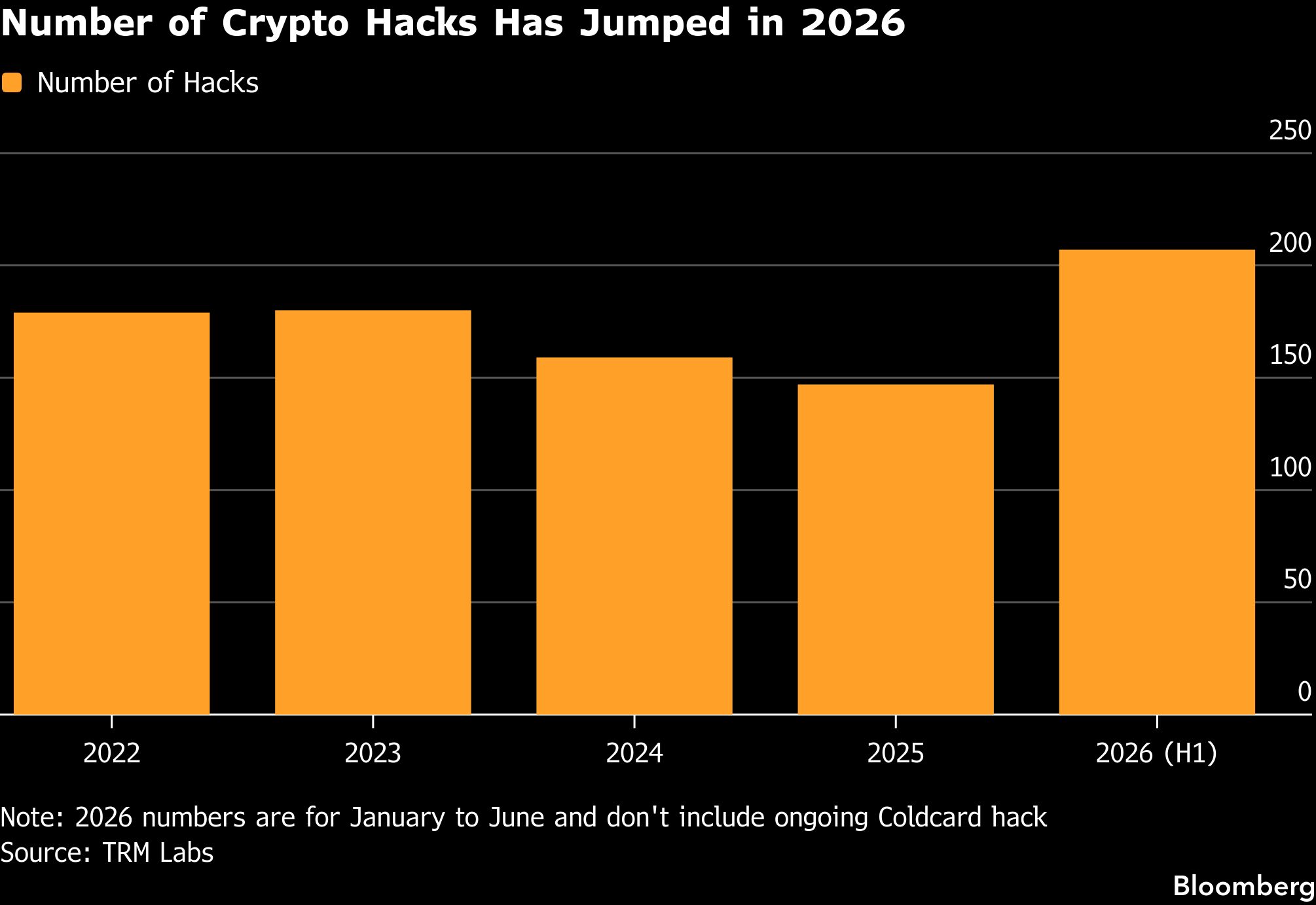
For 2026 so far, the amount of crypto stolen is down from last year. The first half of the year has seen total losses reach $972 million, less than half of the $2.3 billion stolen during the first half of 2025, according to a TRM Labs report published last month. Still, the total number of hacks climbed to 207, the highest recorded in any six-month period.
Ari Redbord, TRM’s global head of policy, said infrastructure and key compromises make up about 15% of incidents while accounting for 76% of losses. “Coldcard shows that self-custody moves the risk, it does not remove it,” he said.
For Goodman, the incident highlighted how much “blind faith” he has put in the technology he uses. He would not be investing in Bitcoin or using cold wallets going forward, he said.
“If it really is this complicated and technical, perhaps it’s not worth doing,” Goodman said. “Nobody knows how basically anything works.”
Photo: Photo credit: Angel Garcia/Bloomberg