Biggest Diesel Shock Since 2022 Deals Another Blow to US Farmers
While US farmers brace for higher fertilizer and chemical bills tied to turmoil in the Middle East, another expense is already taking a bite out of razor-thin margins: diesel fuel.
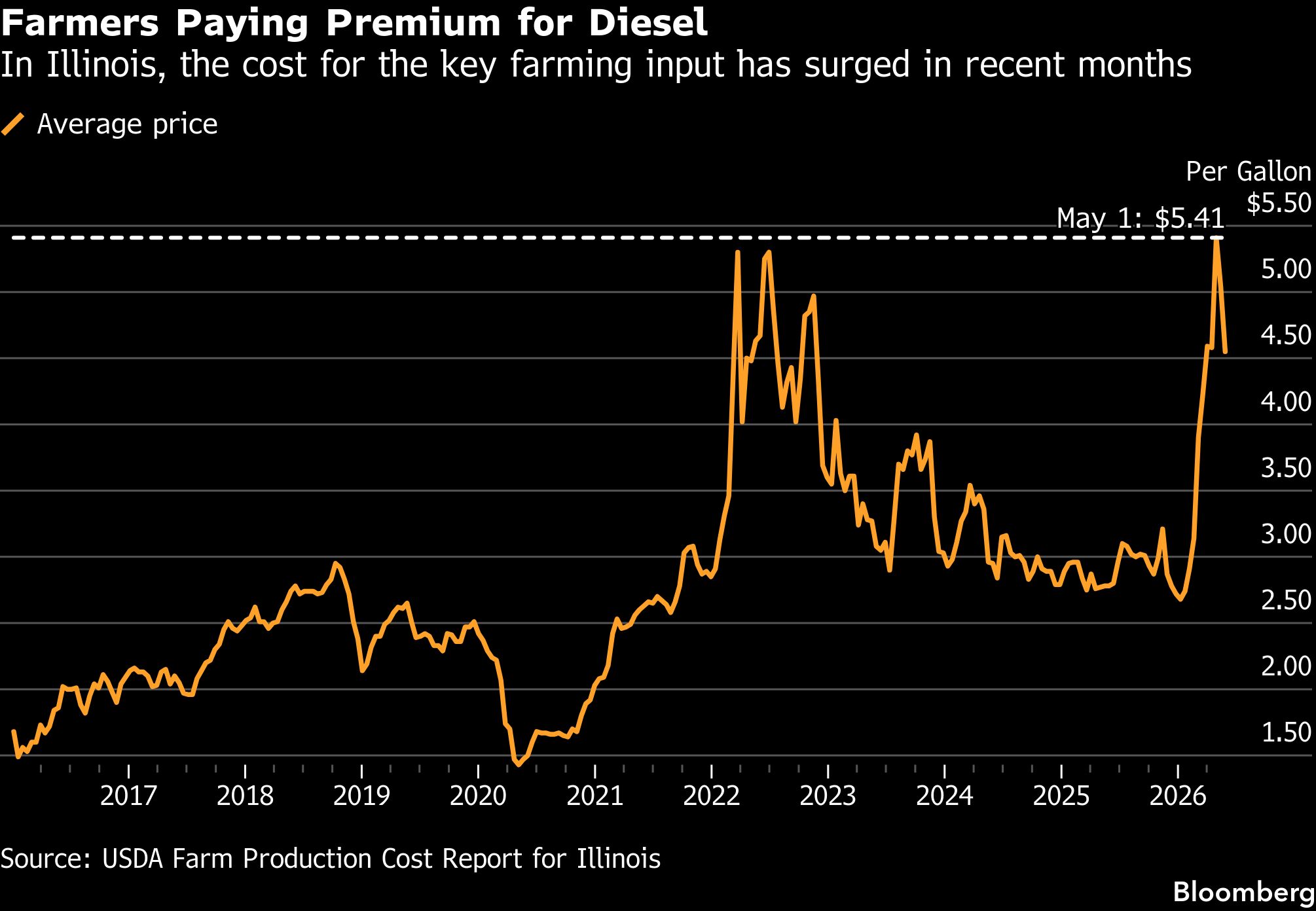
Prices for the fuel that powers tractors, combines and grain trucks have surged as the war in Iran disrupted global oil flows, catching many producers who expected lower energy costs this year off guard. In Illinois, the top US soybean-producing state, farm diesel averaged a record $5.41 a gallon at the start of May, nearly double the price a year earlier.
Current costs, which have moderated some in recent weeks amid prospects for a US-Iran peace deal, still rival levels last seen in 2022 after Russia’s invasion of Ukraine, adding a fresh burden for farmers already facing weak crop prices and mounting financial pressure.
Marty Richardson, who grows corn and soybeans and raises cattle in Missouri, experienced the sticker shock when he recently ordered diesel after running through supplies he bought in January for spring planting.
“I usually get 8,000 gallons, and I got 4,000 for what I paid for the 8,000 gallons in January,” Richardson said. The fuel cost him about $4.74 a gallon. “That is the killer out here right now.”
The spike in diesel, combined with higher prices for fertilizer and crop-protection chemicals produced at facilities in the Middle East, is expected to further eat away at profit margins that were already running negative for the average corn farmer. Data from the US Department of Agriculture show that fuel, fertilizer and pesticides together typically account for about 15% of total production expenses for farmers annually.
Even if the US and Iran finalize a peace deal, it will take time for the war-related premiums on those input prices to dissipate, said Wesley Davis, chief agriculture economist at Meridian Ag Advisors.
“All the stuff being manufactured today is at that higher-cost space, and it’s just going to get passed on in the inventory that gets sold down the channel,” Davis said.
The higher costs threaten to make their way to consumers, with agriculture lender Rabobank in a report estimating mid-single-digit food inflation over the next 12 to 18 months. “Energy is so integrated in the way the food system works,” Tom Bailey, head of consumer for North America at Rabobank, said in an interview.
Producers are feeling the impact now as they burn through diesel while plowing and planting corn and soybeans. They’re also looking ahead to the fall, when they’ll use even more gallons for the massive crop-cutting combines that harvest their fields, as well as the grain carts and semi trucks that haul bushels from farm to market.
“It’s hard enough when you go to the fuel pump and you’re putting 20 gallons in your car at a time, but when you’re buying hundreds at one time, that results in a much different-looking fuel bill,” said farmer Krista Swanson, who is also an economist for the National Corn Growers Association. “When you’re in a tight position, every dollar adds up.”
Corn and soybean farmer Richard Guse said his farm already uses minimum-till practices, leaving little room to cut diesel consumption by eliminating field passes. While he has enough fuel for now, he expects to need more by the end of September.
“The cost of production for everybody goes up with these diesel prices,” Guse said. “The whole farm economy is around diesel fuel.”
The latest Ag Economy Barometer from Purdue University and CME Group showed farmer sentiment declined in May, with high input costs cited as the most important factor limiting improvements in financial performance. About two-thirds of respondents in the survey said they see their farm income dropping in 2026 due to the Iran war.
The jump in diesel has been particularly frustrating because it was one of the few costs growers expected to decline this year, according to CoBank analyst Jacqui Fatka.
“You won’t be able to escape likely higher prices this fall,” she said.
In Iowa, fourth-generation farmer Cordt Holub said his family decided to skip tillage on most of their soybeans this season, helping to save on diesel. Even so, he expects higher fuel prices to hurt in a few months when hauling corn and soybeans about 50 miles to the local processor.
“With a semi that burns five mile a gallon diesel, that adds up really fast,” he said. “And if you’ve got a 200 gallon fuel tank on your semi and you’re putting $5, $6 diesel in there, you can do the math — and you’re filling up every day, every other day.”
Photo: A worker refuels a fertilizer spreader with dyed diesel fuel near Clinton, Missouri. Photographer: Clayton Steward/Bloomberg