Fertilizer Firms See Profit Windfall as War Upends Supplies
Fertilizer makers are seeing a windfall from Iran’s war, highlighting the impact of the conflict’s upheaval on supply chains for the key crop nutrients.
CF Industries Holdings Inc. and Nutrien Ltd. each reported nearly 20% jumps in sales for the latest quarter as they benefited from higher prices for nitrogen fertilizers, which are applied across US corn and soy fields to support crop yields.
While the situation is benefiting the producers, the results are likely to add to concerns from farmers and politicians about inflation in the agriculture markets, after growers have already been struggling with low crop prices and escalating input costs. The upheaval comes after previous disruptions during the pandemic and war in Ukraine.
“The conflict with Iran represents the third major supply and demand shock to the global nitrogen market in the last six years, and has exposed the fragile nature of the global nitrogen supply chain,” CF Industries Chief Executive Officer Chris Bohn said on a Thursday earnings call. “In an environment of frequent geopolitical disruptions, we see distinct value in the true stability of our hard-to-replicate network and superior assets.”
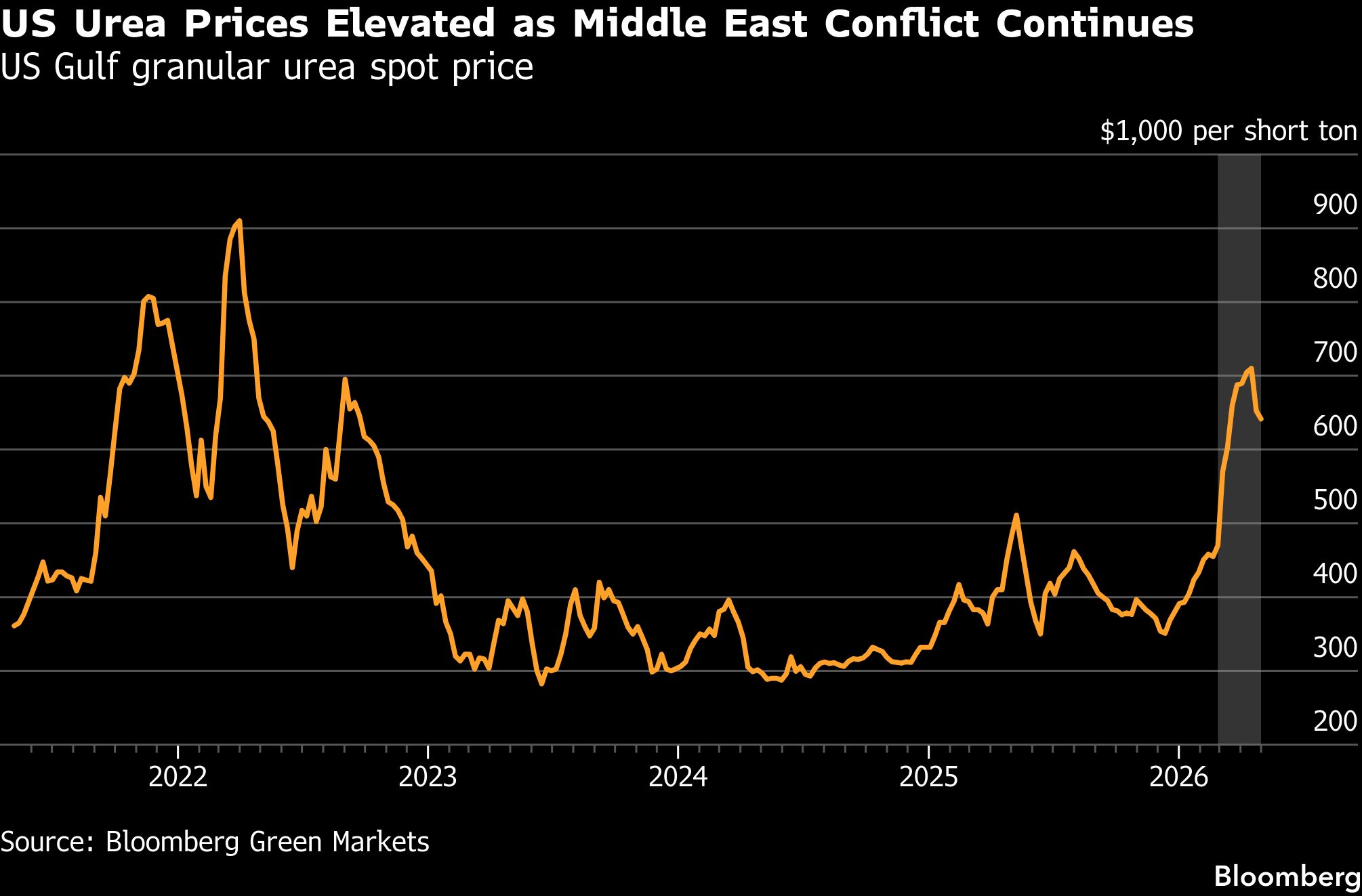
Prices for nitrogen-based fertilizers were already elevated prior to the start of the war due to a tight supply balance, and faced the most dramatic price increase following the closure of the Strait of Hormuz, a key passageway. Granular urea prices in New Orleans are up about 36% since the conflict began in late February, while prices in Egypt have jumped more than 70%, according to Bloomberg Green Markets data as of May 1.
Nitrogen can’t be skipped, so farmers who delayed its use will likely buy the nutrient once supply is available, according to a note from Bloomberg Intelligence senior analyst Alexis Maxwell. Meanwhile, prices for natural gas — which is a necessary input — have not surged as much in the US as in other markets, positioning the producers to capture higher ammonia margins, Maxwell said.
Elevated fertilizer prices have intensified scrutiny on the industry, which is controlled by only a handful of companies in the US. The Justice Department, alongside a spate of probes across agricultural industries, has been investigating whether commercial fertilizer producers have colluded to raise prices, Bloomberg reported in March. The companies haven’t been accused of wrongdoing by antitrust officials, and investigations don’t necessarily lead to charges or lawsuits.
Illinois-based CF Industries reported earnings per share that more than doubled from a year ago. Canada-based Nutrien’s adjusted per-share earnings more than quadrupled, though they fell short of analyst estimates. CF primarily produces nitrogen fertilizers, while Nutrien also manufactures phosphate and potash crop nutrients. Phosphate prices have increased as the strait is a route for the products, but so have costs for the inputs needed to manufacture it.
Despite the strong results, shares in Nutrien fell as much as 7.3% to the lowest price in three months, as the company maintained its prior guidance outlook. CF shares were down as much as 5.4% intraday.
It is “tough to be bullish” on agriculture and fertilizers, Scotiabank analysts Ben Isaacson and Lucy Zhou wrote in a note earlier this week. That’s as higher costs and weaker farmer sentiment weighs on demand. About two-thirds of respondents to a monthly Purdue University survey said they expected their net farm income to drop in 2026 due to the Iran conflict.
“We’re not through the planting season yet, and so there are a lot of things can happen,” Nutrien Chief Financial Officer Mark Thompson said on an earnings call. “We’re not going to at this stage in the planting season and in the year start to make prognostications about how the balance of the season can go.”
Photo: A tractor drips nitrogen fertilizer onto rows of romaine lettuce at Pisoni Farms near Gonzales, California, US, on Wednesday, April 1, 2026. Governments are rushing to secure supplies of critical crop nutrients ahead of spring planting as the Middle East war chokes off the flow of commodities and amplifies fears of a global food crisis.